

Discover the secrets for how to cut a head of lettuce like a pro! I’ll show you how to cut lettuce to achieve the perfect texture and presentation for salads and sandwiches.

Jessica’s Recipe Science
- Cutting lettuce with a sharp knife creates cleaner edges and minimizes cell damage, slow browning, and moisture loss.
- Washing lettuce in cold water helps crisp the leaves because the cells absorb moisture, increasing their firmness and crunch.
- Storing lettuce with a lightly damp paper towel and airflow helps balance moisture, preventing spoilage and wilting.
Why It Works
Instead of grabbing a bag of pricey precut greens, learn how easy it is to cut lettuce to save money. You’ll be surprised how much one head yields, more than double that of store-bought convenience options. Who knew? This is great for making a big salad for a crowd or meal prepping for the week.
The rounded shape and endless leafy layers may seem tricky to break down. Don’t worry! I’ll show you how to cut a head of iceberg lettuce into wedges, chopped pieces, and shreds. The mild flavor makes it a versatile ingredient to add to crisp salads and as a crunchy topping for burgers, wraps, tacos, and more!
Jump To a Section
How to Cut a Head of Lettuce

Step 1: Prep the Lettuce
There are different types of lettuce and leafy greens, but this tutorial focuses on round, crisphead-like icebergs. I will teach you the most common cuts, including wedges, square-shaped pieces, and shreds. Check out my how to cut romaine guide for breaking down large, flat leaves.
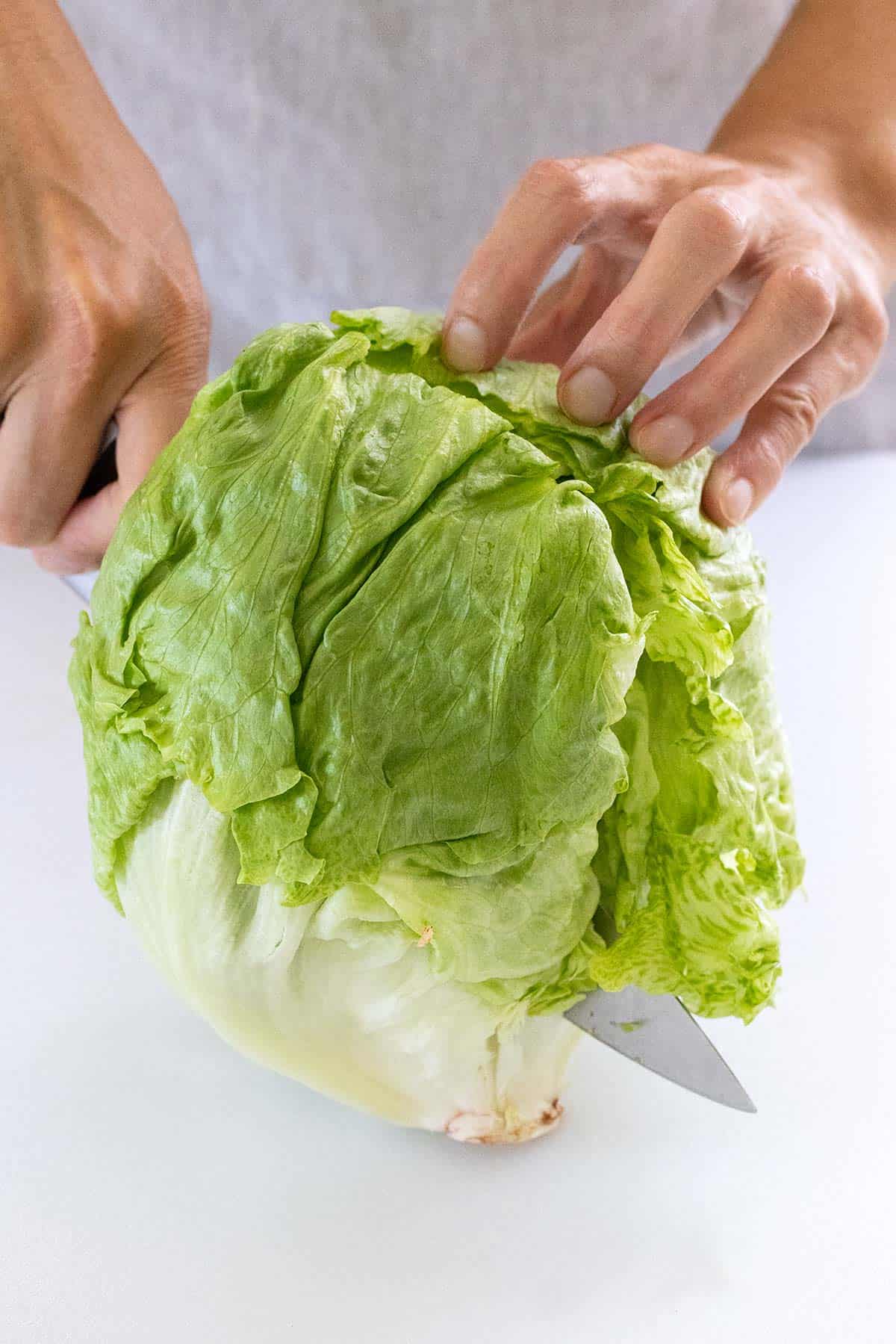
Lay the lettuce on its side and trim about ¼ inch from the stem. The bottom of the stem begins to brown once harvested and cut, so trim off that area. Carefully peel away any outer lettuce leaves that are wilted, bruised, or browned.
Step 2: Cut in Half
It starts with cutting the lettuce head in half with a chef’s knife to make smaller pieces. Stand the head, stem side down, on a cutting board. Use a sharp knife to cut it lengthwise in half, yielding two halves. From here, cut into wedges, shreds, or chopped.
Uses: Remove a few leaves from the core and use the halves as a gluten-free, low-carb burger bun. Use the outer leaves to make chicken lettuce wraps, turkey lettuce wraps, Chicken salad sandwiches, grilled burgers, turkey burgers, or smash burgers.


Step 3: For Wedges
Place the halves, cut side down, on the cutting board. Cut them in half lengthwise to create four wedges. Trim off any tough stems to make it easier to eat, but keep the leaves intact so it retains its characteristic shape. It’s easy to add dressings and toppings to large lettuce leaves for a stunning presentation.
Uses: Wedge salad or garnish for a platter.
Step 4: For Shreds
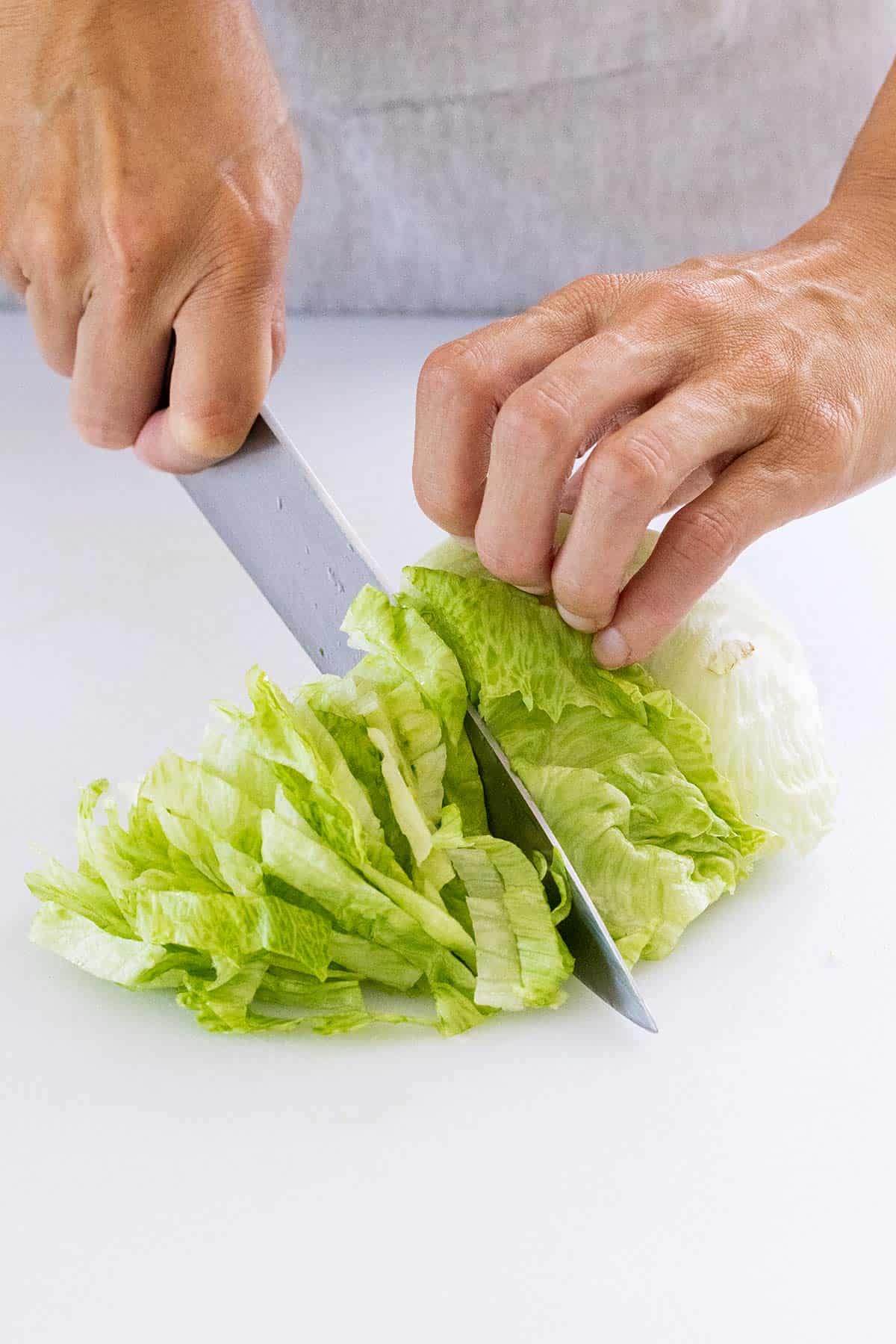
Once the lettuce is cut into wedges, shredding is easy. Make crosswise cuts down the wedge for short shreds, or slice the lettuce lengthwise for super long pieces. Cut into 1/8- to 1/2-inch-wide thin strips or shreds, depending on the recipe. This creates a very light, crisp, and delicate texture.
Use: Top burgers, tuna sandwiches, wraps, chicken tacos, ground beef tacos,shrimp tacos, salads, and garnish for platters.


Step 5: For Chopped
Use the lettuce halves to chop them into smaller bite-sized pieces. Working one half at a time, place them cut side down on the cutting board. Trim any remaining stem by making a “V” cut to remove the more rigid end.
Make about 1-inch-wide parallel cuts lengthwise to make strips. Turn and make perpendicular cuts crosswise to create square-shaped chopped pieces. This size makes it much easier to pick up with a fork for salads.
Uses: Caesar salad, Cobb salad, or Greek salad
Step 6: Wash
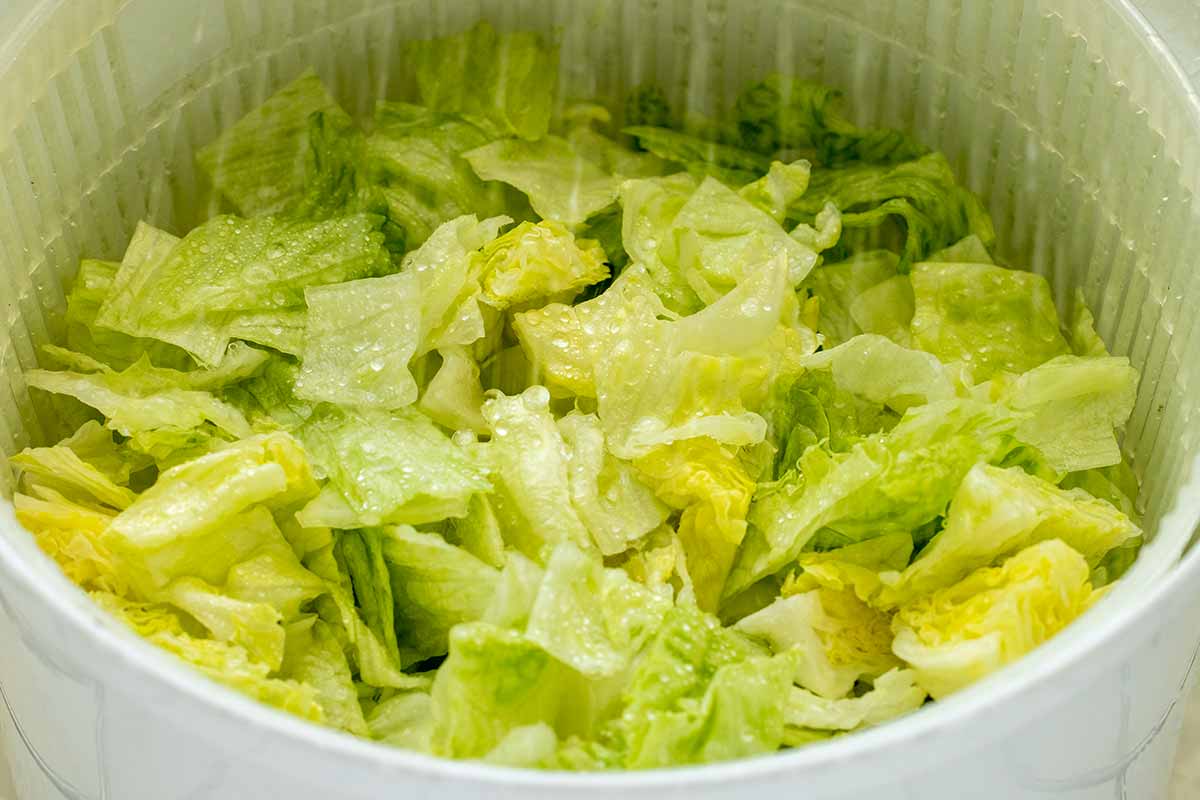
Always wash the cut lettuce or wedges in cold water to remove dirt and debris from the field. Place chopped pieces and shreds in a salad spinner. After rinsing the lettuce, spin it to dry.
Large wedges can be plunged into a large bowl of cold water, gently shaken to remove the excess water, and then dried on a clean towel. Now it’s ready to add to delicious dishes!
Storing Lettuce
Use these methods to properly store lettuce heads and cut pieces to prolong shelf life and maintain crisp texture.
- Whole Heads of Lettuce: Keep intact and do not wash. Wrap the lettuce head in a lightly dampened paper towel, replacing it if needed. Place them in a plastic bag from the store or a large resealable plastic bag. Leave it open at the top for air circulation. Store it in the crisper drawer to keep it fresh. The heads of lettuce will last about 1-3 weeks.
- Chopped Lettuce: Place a lightly dampened paper towel on the bottom of a storage container or in a large resealable plastic bag. Add the cut lettuce and cover, leaving a small opening. If using a bag, seal it, leaving a few inches open to allow air circulation. The lettuce will last in the refrigerator about 3 to 7 days.
Frequently Asked Questions
Remove any wilted or bruised outer leaves. Rinse the outside of the lettuce head, then dry. The leaves can also be pulled apart and washed individually in a large bowl of cold water. Do the same for wedges. Rinse chopped or shredded pieces and dry in a salad spinner.
Use a paring knife to cut away the core. Alternatively, firmly hold the lettuce head with both hands and smash the stem side onto a cutting board. This loosens the core. Pull from the stem end to remove the core.
Cutting lettuce with a chef’s knife is the quickest way to break down the leaves and provide more even shapes and sizes. The blade slices through the leaf’s cell walls, and over time, the cut areas will brown due to exposure to oxygen. Tearing lettuce is great for breaking it down into rustic bite-sized pieces. If the leaves are torn around the cell wall boundaries, they can rupture fewer cell walls, but the difference in browning is insignificant.
Store in an airtight container or large resealable bag with a lightly damp paper towel. The moisture will help keep the leaves damp and fresh for 3 to 7 days.
More Knife Skills


If you found this guide for How to Cut Lettuce helpful, please leave a 🌟 star rating and let me know how it went in the 📝 comments below!
How to Cut a Head of Lettuce

Ingredients
- 1 head iceberg lettuce
Instructions
- Prep the Lettuce – Trim off the stem, removing any brown areas. Remove any outer leaves that are bruised or wilted.
- Cut in Half – Place the lettuce head on a cutting board. Cut in half lengthwise, yielding two pieces. Proceed to make wedges, chopped pieces for salad, or shreds.
- For Wedges – Cut the two halves in half lengthwise. This will create four wedges. Trim off any tough stems from each piece.
- For Shreds – Cut the two halves in half lengthwise. This will create four wedges. Working one at a time, slice crosswise to make short shreds. Slice lengthwise for long shreds.
- For Chopped – Make an angled "V" cut to trim off the stem from each half. With the cut side down, make 1-inch thick slices lengthwise down the half. Turn and chop to make 1-inch pieces. Repeat with the remaining half.
- Wash – Add the shredded or chopped lettuce to a salad spinner. Rinse well with cold water. Spin until the leaves are dry. Submerge the wedges in cold water. Gently shake to remove the water. Cover and refrigerate if not using immediately.
Recipe Video

Equipment
Notes
- Yield: About 10 to 12 cups chopped for a head of iceberg lettuce.
- Storing: Wrap a whole head in a lightly damped paper towel and store it in a plastic bag with an opening for 1 to 3 weeks. Cut lettuce can be stored in a container or large plastic bag with a lightly dampened towel, leaving a small opening for about 3 to 7 days.
- Reviving Wilted Lettuce: Place the leaves or cut pieces in a container of ice water for about 15 to 30 minutes until crisp.
Nutrition Facts
Percent Daily Values are based on a 2000-calorie diet. All nutritional information is based on estimated third-party calculations. Each recipe and nutritional value will vary depending on the brands you use, measuring methods, and portion sizes per household.


Sher says
In my world, you slam the head down on the core and pull it all out. Then you NEVER use a knife if you are not going to eat all of that lettuce or won’t be eating it for a while as the edges turn brown. I use a lettuce knife. Hard plastic with a serrated edge. 🙂
Jessica Gavin says
I’ll have to check out a lettuce knife! Would love to test the difference in browning on the leaves when cut.
Judy says
So interesting. I love these lessons. You are amazing. Thank you Jessica.
Jessica Gavin says
Hope you find the tutorials helpful, Judy!